

Why This Comparison Matters
Lymphoria has been hard to miss this year. Their page runs a promo widget at $29.99, $59.99 and $89.99, quotes a 12-week observational study on 200 adults, and puts a "Clinically Backed" checkmark on a marketing graphic. That is a confident pitch for a herbal tincture, so we bought a bottle and read the label.
Then we read Flow's label next to it. Cleavers Aerial Parts, Red Clover Flower, Stillingia Root, Prickly Ash Bark. A 300 mg proprietary blend. Vegetable glycerin and water. Serving size 1 mL, 59 servings per container. Every line matched, and a few paragraphs of the sales copy match word for word as well. Which means the question a comparison like this normally answers, whose formula is better, has no answer. There is nothing between them to find.
So we went after the two things that can still differ when the liquid is the same. What each brand charges once you get past the promo widget and into the actual checkout, and whether the claims on each page can be traced back to anything. That is where they stop looking alike.
At A Glance: Flow vs. Lymphoria
Both labels and both checkouts, side by side, before we go section by section.
| Spec | Flow | Lymphoria |
|---|---|---|
| Herbal blend | Cleavers, Red Clover, Stillingia, Prickly Ash | Cleavers, Red Clover, Stillingia, Prickly Ash |
| Blend size | 300 mg proprietary blend | 300 mg proprietary blend |
| Amount of each herb disclosed | No | No |
| Servings per bottle | 59 | 59 |
| Bottle size | 2 fl oz (60 mL) | 2 fl oz (59 mL) |
| Alcohol-free | Yes | Yes |
| Certificate of analysis published | No | No |
| Best-value bundle (5 bottles) | $89.99 | $119.98 |
| Advertised price matches checkout | Yes | No |
| Money-back guarantee | 30 days | 30 days |
| Subscription cadence | Every 30 days only | 1, 2 or 3 months |
Green text marks the advantage. Most rows here are a genuine tie, and we left those unmarked.
What's Actually In The Bottle
We started where any comparison should start, with the supplement facts panel on the back of each bottle. Both labels are photographed on both websites, so anyone can check this. We read them line by line, and the result surprised us enough that we read them twice.
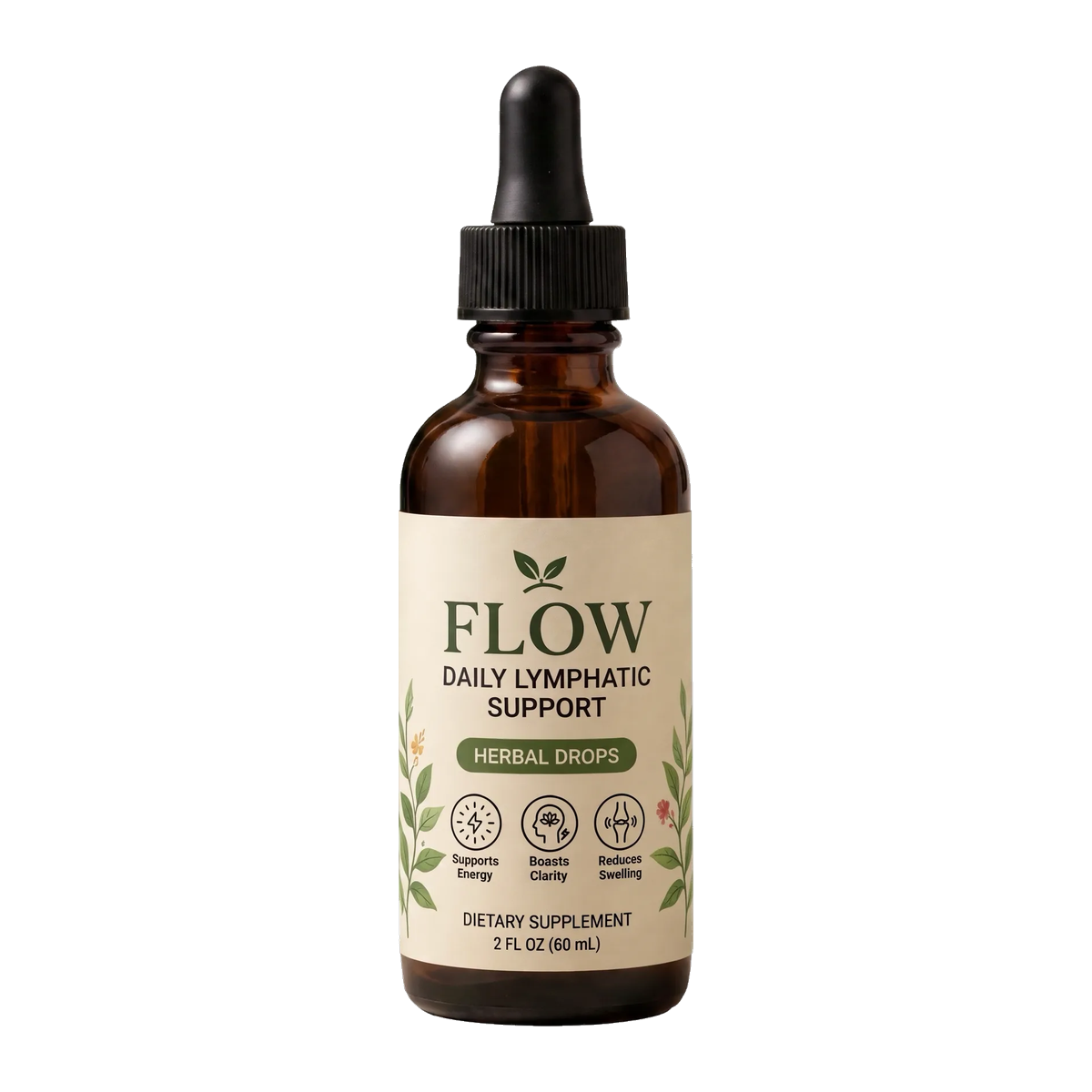
- Proprietary blend of 300 mg per 1 mL serving, 59 servings in the bottle
- Four herbal extracts: Cleavers Aerial Parts (Galium aparine), Red Clover Flower (Trifolium pratense), Stillingia Root (Stillingia sylvatica), Prickly Ash Bark (Zanthoxylum americanum)
- Other ingredients: vegetable glycerin and water. That is the whole list.
- Alcohol-free, vegan, gluten-free, non-GMO, no added sugar, no artificial additives
- Because the blend is proprietary, the label does not say how many mg of each herb you get

- Proprietary blend of 300 mg per 1 mL serving, 59 servings in the bottle
- The same four extracts in the same order: Cleavers Aerial Parts (Galium aparine), Red Clover Flower (Trifolium pratense), Stillingia Root (Stillingia sylvatica), Prickly Ash Bark (Zanthoxylum americanum)
- Other ingredients: vegetable glycerin and water
- Alcohol-free, vegan, gluten-free, non-GMO, no added sugar, no artificial additives
- Also a proprietary blend, so the per-herb amounts are hidden here too
There is nothing to pick between them. Same four herbs, same 300 mg blend, same glycerin and water base, same 59 servings. If you were hoping the ingredients would explain why one of these costs more than the other, they don't. We're scoring this a tie and we'd score it a tie again tomorrow. Worth saying plainly about both: a proprietary blend is a legal way of not telling you the individual doses. 300 mg is the only number either company puts on the label, and neither one will say whether that is mostly cleavers, mostly red clover, or an even split.
Sourcing, Testing & What You Can Verify
Every supplement brand says its product is tested. The useful question is whether you can actually see the test. We went looking for a lab name, a batch report, a certificate of analysis, anything a buyer could open and read. Here is what we found on each side.
- Made in a GMP facility
- Label and website both say the drops are tested by an outside lab
- No certificate of analysis published, and no testing lab named
- No batch report you could look up before you buy
- Amber glass bottle, 2 FL OZ (60 mL), black cap with a bulb dropper, cream label
- Does not put a "Clinically Backed" badge on anything
- Also made in a GMP facility
- Also says the drops are tested by an outside lab
- Also no certificate of analysis, no lab named, no batch report
- Amber glass bottle, 2 FL OZ (59 mL), same style of cap and dropper, cream label with dark green bands
- Runs a "Clinically Backed" checkmark on a marketing graphic with no study attached to it
Another tie, and we want to be honest about how close it is. Neither company will show you a lab report. Both make the same claim about outside testing and then leave it there, which is common in this category and still not good enough from either of them. Flow's edge is narrow: it doesn't stamp "Clinically Backed" on a graphic when there is no clinical work to point at. That is restraint, not proof of a better bottle, and we've scored it accordingly. If either brand published a real certificate tomorrow, this section would be theirs outright.
Taste & The Daily Ritual
A supplement you dread is a supplement you quit by week two. Twice a day for weeks is a real commitment, so we cared about how these actually go down. Same glass, same water temperature, same time of morning, both bottles.
- Honey flavored and alcohol-free, so there is no burn on the tongue
- 1 mL, roughly 15 to 20 drops, stirred into water twice a day
- Can also be held under the tongue for about 30 seconds if you'd rather skip the glass
- Sweet enough in plain water that you don't need juice to chase it
- Glass pipette draws the dose cleanly, so the morning routine takes seconds
- Also honey flavored and alcohol-free
- Same 1 mL dose, roughly 15 to 20 drops, twice a day in water
- Same sublingual option, about 30 seconds under the tongue
- Same glass pipette, same amber bottle in your hand
- We tasted the two back to back and could not tell which was which
A tie, and not a polite one. Same honey flavor, same alcohol-free base, same 15 to 20 drops in a glass of water morning and night, same option to hold it under your tongue instead. We poured both and went back and forth, and after a while we stopped trying to find a difference. If you switched brands mid-bottle you would notice it on the receipt, not on your tongue.
Dosing & How Long A Bottle Lasts
This is the number that decides what a year of either product costs you, and both labels answer it the same way. The arithmetic takes about ten seconds, which is roughly nine seconds longer than most people spend on it before they hit checkout.
- Serving size is 1 mL, about a quarter teaspoon
- 59 servings per container, printed on the label
- Directions say twice daily, so one bottle covers roughly 30 days
- 2 FL OZ (60 mL) amber glass bottle
- Subscription refills ship every 30 days and you can cancel any time
- Twelve bottles a year at the directed dose, which is what our cost math below is built on
- Serving size is 1 mL, the same quarter teaspoon
- 59 servings per container, the same as Flow
- Directions say twice daily, so again about 30 days per bottle
- 2 FL OZ (59 mL) amber glass bottle
- Twelve bottles a year at the directed dose, identical to Flow
- Subscription delivery runs on a 1, 2 or 3 month cadence, which is more flexible than Flow's 30-day refill
Identical again. One milliliter twice a day out of 59 servings gives you about a month per bottle from either brand, so twelve bottles a year either way. Lymphoria does win one thing here, and it deserves the credit: you can set its subscription to arrive every one, two or three months, while Flow only offers a 30-day refill. If you like to stock up and forget about it, that is a real point in Lymphoria's favor. What it does not change is the price of those twelve bottles, which is where this comparison stops being a tie.
The Claims Each Brand Makes
Two bottles of the same formula, and the marketing around them reads very differently. We went through every number both brands print and tried to trace each one back to something we could actually read.
- Prints three percentages and says on the same line where they came from: a survey of its own customers
- 93% woke up with less puffiness and swelling, 91% said their skin looked clearer
- 95% reported better circulation and energy, again as customer answers rather than trial data
- Gives a timeline you can hold it to: a lighter feeling in 7 to 10 days, visible change around 7 to 14
- Says the best of it shows up at three to four weeks, which is slower than most supplement pages admit
- Puts no clinical badge on any graphic, because there is no trial to point at
- Describes a real study design in detail: 12 weeks, 200 adults, ages 35 to 68
- No journal, no author, no institution and no link appears anywhere on the site to go with it
- The headline finding, that "78% of daily issues" trace back to a slowed lymphatic system, sits there with nothing to check it against
- A "Clinically Backed" checkmark appears on a comparison graphic, and that graphic is the whole of the evidence
- Uses the same florid "hardened lymph sludge" language Flow uses, so that one is a wash
- Review counts on a single page read 14,753+, then 736, then "10K+ customers", with the rating flipping between 4.9 and 4.8
Let's be fair before we score this. Neither brand has a doctor, a physician or any clinician backing it, and neither publishes a lab report. Flow's own copy leans on the same overheated "sludge" imagery Lymphoria does. So this is not evidence against no evidence. Both brands are working with survey numbers and vibes. The difference is that Flow labels its 93/91/95 figures as what its buyers told it, which is a claim you can weigh for what it is. Lymphoria dresses a 200-person study and a "Clinically Backed" tick in the language of science and then never names the study. Add the review counts contradicting each other three times on one page and you get a brand that is harder to take at its word. Flow takes this one, on transparency rather than proof.
Price, Guarantee & What You Actually Pay
We put both bundles through checkout with a card in hand, because an advertised price and a charged price are not always the same number. On one of these sites they were not.
- One bottle is listed at $29.99, down from $39.99, and $29.99 is what the card gets charged
- Buy 2 Get 1 Free is $59.99, or $19.99 a bottle, down from $79.99
- Buy 3 Get 2 Free is $89.99, or $17.99 a bottle, down from $119.99
- 30-day money-back guarantee, worded the same way on the product page and in the FAQ
- Runs subscription delivery on a 1, 2 or 3-month cadence, which is more choice than Flow gives you
- The promo widget on the page shows $29.99, $59.99 and $89.99. Checkout rings up $39.99, $79.98 and $119.98
- That is $10 more on a single bottle and $30 more on the five-bottle bundle, for the same formula
- The product page promises a 30-day money-back guarantee. The FAQ on the same site says 60
Lymphoria earns a point here and we're giving it to them outright: you can set your refills to arrive every one, two or three months, while Flow only does 30 days. If you go through a bottle slowly, that flexibility is worth something. Then you reach the payment screen. The three prices Lymphoria puts in front of you on the way in are not the three prices it takes on the way out, and the gap on the biggest bundle is $30. We are not going to tell you why that is, because we don't know. We can only tell you that Flow's advertised prices and Flow's charged prices are the same numbers, and that a brand which can't keep its own guarantee straight between the product page and the FAQ has already made this call for us.
The Real Cost of Ownership
A bottle is 59 servings, which at 1 mL twice a day is about a month. So a year is roughly 12 bottles, or 2.4 of the five-bottle bundles. Here is what that adds up to at each brand's best price.
Buying the five-bottle bundle at each brand's checkout price, Flow runs about $216 a year and Lymphoria about $288. That is $72 more per year for a bottle with the same four herbs, the same 300 mg blend and the same 59 servings in it. Stay on it for five years and the gap is roughly $390. Nobody is going bankrupt over $72. It is just money you would be paying for nothing you can point to.
Price & Value
Everything we found, side by side, with the prices taken from the checkout screen rather than the sales page.
- ✅ Buy One at $29.99, down from $39.99
- ✅ Buy 2 Get 1 Free at $59.99, which is $19.99 a bottle, down from $79.99
- ✅ Buy 3 Get 2 Free at $89.99, which is $17.99 a bottle, down from $119.99
- ✅ Checkout charges the advertised price, all three tiers
- ✅ 2 FL OZ (60 mL) amber glass bottle, 59 servings
- ✅ 1 mL twice daily, so a bottle covers about 30 days
- ✅ 300 mg blend of cleavers, red clover, stillingia root and prickly ash bark
- ✅ Honey flavored, alcohol-free, vegan, gluten-free, non-GMO
- ✅ Survey figures labelled as survey figures: 93%, 91%, 95%
- ❌ Refills ship on a 30-day cycle only, with no 1, 2 or 3-month option
- ✅ 30-day money-back guarantee, one number, stated once
- ✅ Same 300 mg blend, same four herbs, same other ingredients
- ✅ 2 FL OZ (59 mL) amber glass bottle, 59 servings
- ❌ Promo widget advertises $29.99 for one bottle. Checkout charges $39.99
- ❌ Buy 2 Get 1 Free advertised at $59.99, charged at $79.98
- ❌ Buy 3 Get 2 Free advertised at $89.99, charged at $119.98
- ❌ $30 more than Flow for five bottles of the same thing
- ✅ Honey flavored, alcohol-free, vegan, gluten-free, non-GMO
- ✅ Subscription on a 1, 2 or 3-month cadence, wider than Flow's 30 days
- ❌ "Clinically Backed" tick on a graphic, with no study named to back it
- ❌ Review count reads 14,753+ in one spot, 736 in another, "10K+ customers" in a third
- ✅ 30-day money-back guarantee on the product page
- Worth knowing: the FAQ on the same site promises 60 days, not 30
Read those two columns again and notice how much of them is identical. Same herbs, same 300 mg, same 59 servings, same honey taste, same month per bottle. We could not find a single thing inside the bottle that separates them, and we looked hard. What separates them is the till. One bottle: $29.99 against $39.99. Five bottles: $89.99 against $119.98. Lymphoria gives you the better subscription schedule and we said so. It is not worth $30 a bundle. If the formula is a draw, the cheaper one wins, and the one that charges what it advertises wins twice.
